LOGOLOGOLOGOLOGO
    • About us
      • What we do
      • Who we are
        • Governance
        • Staff
        • Vacancies
    • Members
      • EuropaBio Members
      • About Membership
    • How we work
      • Healthcare Biotechnology Council
        • Patient BioForum
        • Study – Impact of the EU’s General Pharmaceutical Legislation
      • Industrial Biotechnology Council
        • EFIB
        • Microorganisms
      • National Associations Council
      • SME Platform
      • Biomanufacturing Platform
        • Biotechnology in our Lives
    • Activities
      • 25 Years of Innovation
      • The EU Biotech Act
      • European Biotech Week
      • EU Projects
        • PRIMED Project
        • APROVALS Project
    • News & Events
      • News
      • Events
    • Library
    Become a member
    ✕

    Webinar Report: Measuring the Economic Footprint of the Biotechnology Industry in Europe
    05/03/2021
    NEWS RELEASE

    Webinar Report: Measuring the Economic Footprint of the Biotechnology Industry in Europe

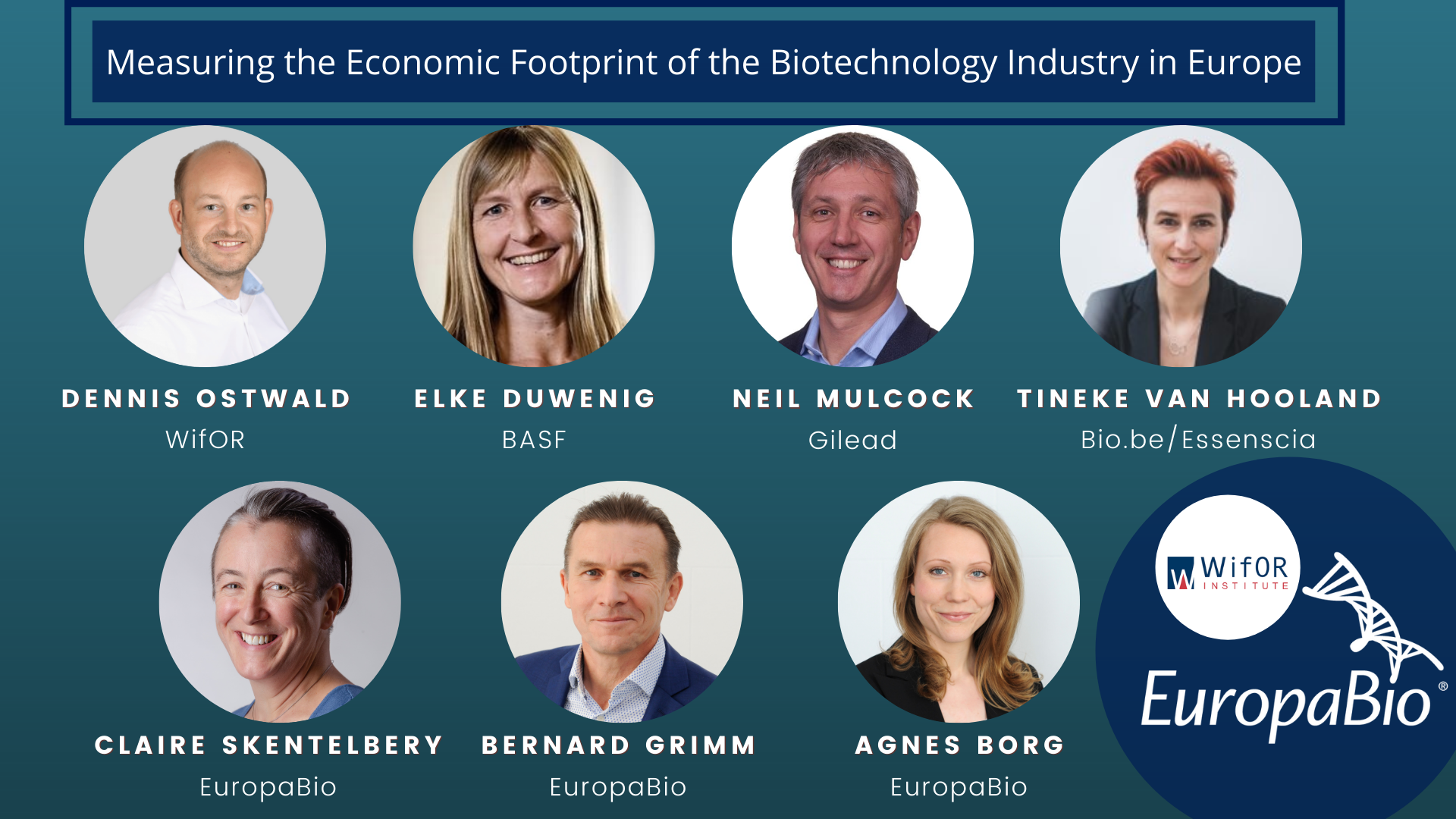
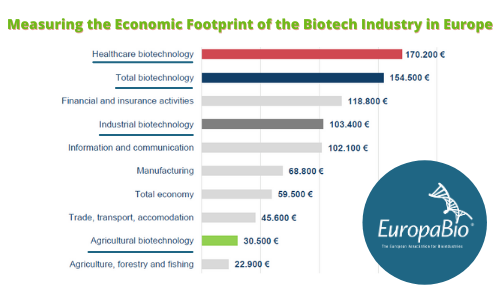
    On March 4, 2021, EuropaBio hosted the event ‘Measuring the Economic Footprint of the Biotechnology Industry in Europe’ to showcase the same-titled report.

    The study, from the WifOR Institute, looked at the economic impact of the biotechnology industry within the (then) 28 European member states, in terms of gross value added (GVA), employment and trade in 2018.

    European GDP benefitted by €38.5 bn and, including spill over effects, that number rises to €78.7bn. The direct contribution adds up to about 1.5% of total industrial GVA within the countries assessed, supported by 223,000 direct jobs rising to over 700,000 with associated employment.

    The event brought together the report authors to present their findings in full, and a panel discussion with EuropaBio Members BASF, Gilead, and Bio.be/Essenscia to plot the future economic pathway for biotechnology across sectors.

    The webinar then closed with EuropaBio Council Directors Bernard Grimm and Agnes Borg presenting industry policy and regulatory priorities from Members, where EuropaBio works to achieve the robust ecosystem biotechnology economic and societal contributions.

    The full webinar recording is available HERE.

    The webinar slides are available for download BELOW.

    SLIDES
    Measuring the Economic Footprint of the Biotechnology Industry in Europe


    Download
    20210304_Economic_Footprint_SLIDESDownload
    Share
    Communications Team
    Communications Team

    Related posts

    18/05/2026

    Biodefence & Biosecurity in focus for EuropaBio with dedicated Task Force


    Read more
    12/05/2026

    ‘Consistency, cooperation and practicality are the watch words’. EuropaBio reacts to provisional agreement on the Critical Medicines Act


    Read more
    08/05/2026

    Technovative Solutions Ltd. joins EuropaBio: Advancing AI‑Driven and Sustainable Innovation in Biotechnology


    Read more

    Important links

    • Biodefence & Biosecurity in focus for EuropaBio with dedicated Task Force
    • ‘Consistency, cooperation and practicality are the watch words’. EuropaBio reacts to provisional agreement on the Critical Medicines Act

    Categories in our Newsroom

    EBIO-white

    EuropaBio represents corporate and associate members across sectors, plus national and regional biotechnology associations which, in turn, represent over 5000 biotech companies, 4600 out of them are SMEs.

    Contact us

    Extra links

    Members
    Staff
    Privacy policy
    Legal & cookies
    Events
    Newsroom

    Become a member

    Media pack

    © 2026 Europabio. All Rights Reserved. Designed by EYAS
    Become a member

    Vitamin B2

    The biomanufacturing of Vitamin B2 led to the reduction of 75% of fossil raw materials and 50% operating costs, compared to the chemical process. Vitamin B2 is used in the food, feed or healthcare sectors.

    Insulin

    Insulin is one of the most widely known biopharmaceutical. Biotechnology revolutionised its manufacturing process and led to the development of new types of insulin through r-DNA technology.

    Detergents

    Enzymes and biosurfactancts are alternative ingredients that improve the performance of detergents, while leading to water and energy savings and reductions in CO2 emissions and water toxicity.

    Clothes

    Clothes made from alternative fibres produced by microorganisms can be 8x stronger than steel, 100% recyclable, biodegradable and replace fossil-fuel based or resource-intensive textiles.

    Algal Omega 3

    Algal Omega-3 is an innovative feed product for aquaculture. It reduces the impact on climate change by 30-40% compared to fish oil and saves 60 tons of wild fish for every ton of Algal Omega-3 used.

    Cheese

    Cheese is a vegetarian product thanks to biotechnology. Biotechnology is also essential to produce lactose- or cholesterol-free cheese, as well as alternative proteins.